
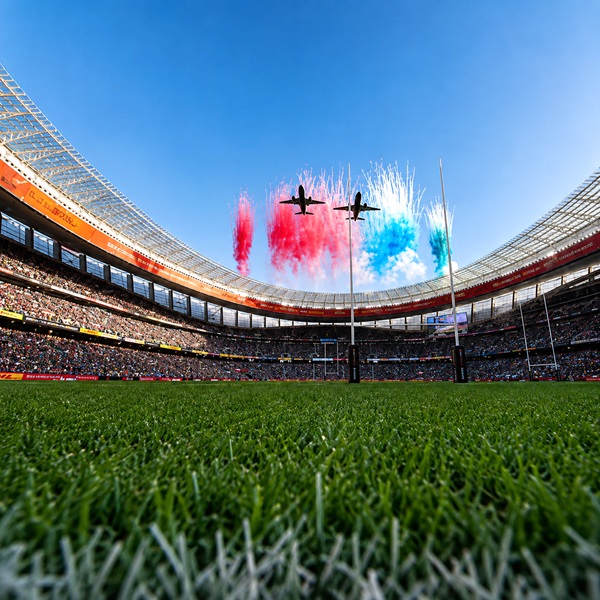
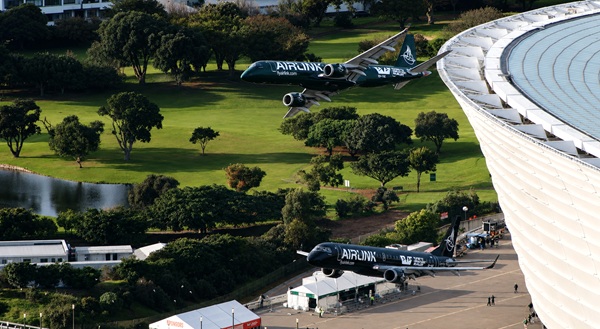
For a few extraordinary seconds, two Airlink passenger jets appeared to skim the roof of Cape Town’s DHL Stadium. Thousands of spectators were waiting for the Springboks to face the All Blacks on Saturday, 29 August 2026, when the two Embraer aircraft swept over the stadium in close formation. One was painted green and the other black, reflecting the colours of the two rugby teams as part of Airlink’s involvement in Rugby’s Greatest Rivalry tour. Videos of the flypast quickly spread across social media and beyond South Africa. From some camera angles, the aircraft appeared almost impossibly close to the stadium roof. That left aviation fans and ordinary viewers asking the same question:
Just how low were the Airlink planes actually flying?
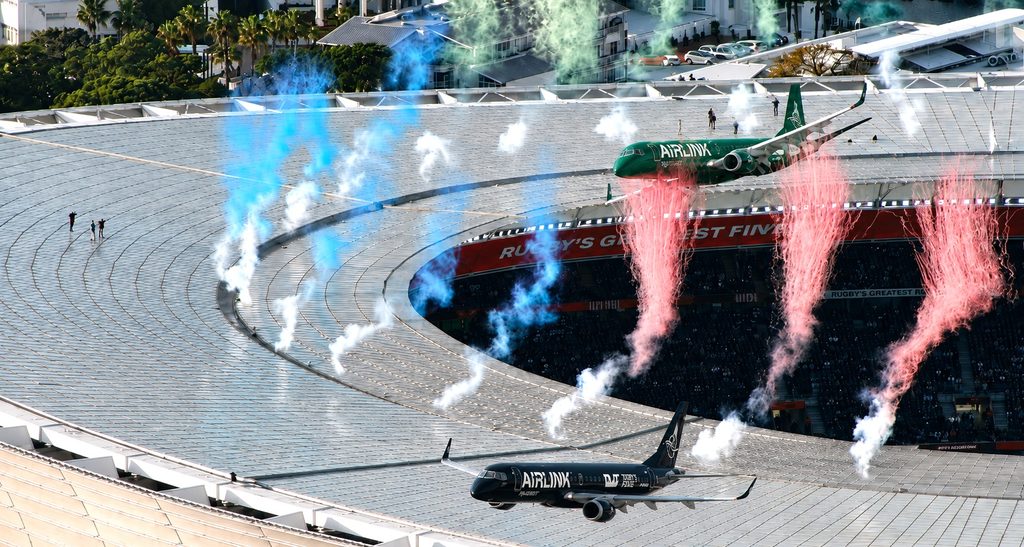
Flight-tracking analysis provides an extraordinary estimate: the lead aircraft may have cleared the roof of DHL Stadium by only 41- 46 feet (approximately 12.5 – 14 metres). Flightradar24 therefore concluded that the aircraft passed less than 50 feet above the top of the stadium.That’s roughly comparable to the height of a four-storey building.
And although camera perspective undoubtedly made some videos look even more dramatic, this was not simply an optical illusion. The aircraft really were flying exceptionally close to the stadium.
How low did the Airlink planes fly over DHL Stadium?
Aircraft tracking data normally reports altitude in relation to mean sea level rather than directly measuring the distance between an aircraft and whatever happens to be beneath it. That makes determining the actual clearance above a stadium more complicated than simply reading an altitude number from a flight-tracking app. Flightradar24 analysed the lowest ADS-B altitude reported by the lead aircraft, adjusted that figure for local atmospheric pressure and compared it with the estimated height of DHL Stadium.
Its analysis produced an estimated clearance of approximately: 41 – 46 feet (12.5 – 14 metres) above the stadium roof.
Airlink Cape Town flyover at a glance
Estimated roof clearance: 41 – 46 ft / 12.5 – 14 m
Reported flypast speed: Around 150 knots / 278 km/h
Aircraft: Embraer E190 (ZS-YAE) and Embraer E195 (ZS-YDE)
Registrations: ZS-YAE and ZS-YDE
Passengers onboard: None
Flight crew: Three senior captains aboard each aircraft
The numbers help explain why footage from inside and around the stadium looked so remarkable. Commercial airliners are normally seen at very low altitude when approaching or departing an airport. Seeing two relatively large passenger aircraft in formation just metres above a packed sports venue is therefore an unusual sight for most people.
Why did Airlink fly over the stadium?
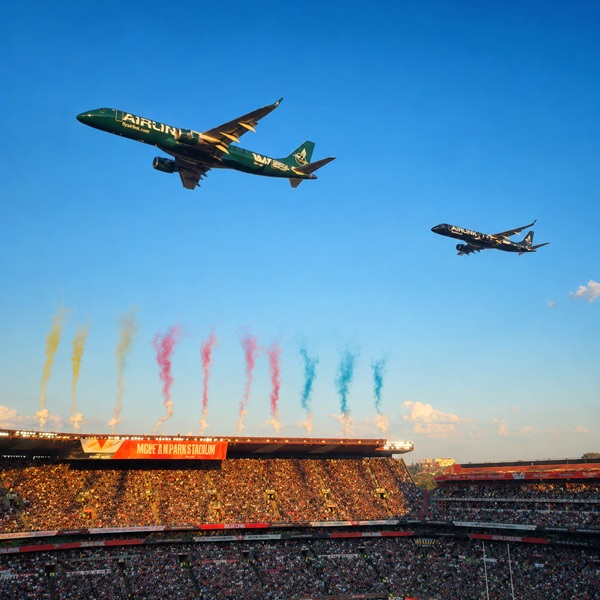
The display was connected to the 2026 Rugby’s Greatest Rivalry series between South Africa and New Zealand. Airlink is the tournament’s official domestic airline partner and is responsible for transporting participating teams, coaches, management and support personnel between matches taking place in South Africa. The airline also painted two of its Embraer aircraft in distinctive colours associated with the event. The green aircraft, registration ZS-YAE, is an Embraer E190, while the black aircraft, ZS-YDE, is an Embraer E195. Both carry Rugby’s Greatest Rivalry branding.
Cape Town wasn’t the first appearance of the pair. A week earlier, on 22 August, Airlink used the same two specially liveried aircraft for another formation flyby over Ellis Park in Johannesburg before the Springboks faced the All Blacks. The Cape Town pass, however, attracted significantly more international attention because of how close the aircraft appeared to DHL Stadium’s roof.
Which aircraft performed the Cape Town flyover?
Despite some early online descriptions referring simply to two Embraer jets, the formation actually involved two different members of the Embraer E-Jet family.
They were:
Embraer E190 (ZS-YAE)
ZS-YAE was the green aircraft in the formation. Airlink unveiled its distinctive green paint scheme in June 2026. The aircraft also carries branding connected with Airlink’s Skybucks loyalty programme and Rugby’s Greatest Rivalry tournament.
Embraer E195 (ZS-YDE)
The second aircraft was Embraer E195 ZS-YDE, wearing the corresponding black Rugby’s Greatest Rivalry colour scheme. Flightradar24 identified the Cape Town formation as consisting of E195 ZS-YDE and E190 ZS-YAE. The Embraer E190 and E195 are regional passenger jets normally used to carry passengers on commercial routes. The aircraft are typically deployed across Airlink’s domestic and regional network, including routes to destinations such as Harare, Bulawayo, Victoria Falls, Lusaka, Livingstone, Maputo, Windhoek, Gaborone and Dar es Salaam. During this flypast, however, the aircraft were not operating regular passenger services.
Were passengers onboard the Airlink planes? No.
Although the aircraft involved normally operate scheduled passenger services, Airlink did not carry passengers during the stadium flyover. Each aircraft instead had three senior captains onboard. Airlink said they performed the roles of commander, co-pilot and safety/technical officer. That distinction matters. The viral footage did not show two normal scheduled Airlink services being deliberately diverted over a stadium with passengers onboard. These were aircraft being specifically operated for a planned flypast.
Was the Airlink stadium flyover approved? According to Airlink, yes.
After the spectacular footage generated both praise and concern online, the airline released a statement explaining that the operation required careful planning and rehearsal. Airlink said the South African Civil Aviation Authority (SACAA) and Air Traffic Navigation Services (ATNS) provided guidance, approval and support for the flypast. The airline also said the aircraft flew at approximately 150 knots, or around 278 km/h, and that data recorded onboard indicated they remained within the approved and rehearsed altitude and speed limits. However, the extremely low profile has also generated a wider aviation safety debate. Airlink has voluntarily provided flight-recorder data from both aircraft to SACAA so the regulator can independently review and verify whether the flypast was conducted in accordance with its authorisation. That distinction is important. Airlink maintains that the operation complied with its approved flight profile. The submission of flight-recorder data gives the aviation regulator an opportunity to independently assess what occurred. The fact that an aircraft passed extremely close to a structure does not by itself prove that an unsafe or unauthorised operation took place. Equally, the unusually small apparent margin has understandably prompted aviation professionals and observers to ask how the risks involved in such a manoeuvre were assessed. Those questions include factors such as aircraft performance, weather, obstacles, emergency options, the flight path and what margins would remain if something unexpected occurred. The regulator’s assessment of the recorded flight data should therefore provide greater clarity.
Why did the Airlink aircraft look even closer on video?
Some videos from DHL Stadium make the aircraft look almost as though they are touching the roof. Camera perspective can exaggerate that appearance. A zoomed camera compresses the apparent distance between objects, while a large fixed structure such as a stadium roof gives viewers a very strong visual reference against which to judge the aircraft. The jets were also moving quickly, while pyrotechnics and smoke around the stadium added to the dramatic appearance. But in this case, perspective only tells part of the story. Flightradar24’s independent analysis still places the lead aircraft less than 50 feet above the stadium roof. In other words, some camera angles may have made the flypast look even closer than it was, but the actual estimated clearance was still remarkably small.
South Africa’s famous rugby flyover tradition
Aircraft appearing above major South African sporting events isn’t a new phenomenon. Perhaps the country’s most famous stadium flypast took place more than three decades ago.
On 24 June 1995, South Africa was preparing to face New Zealand in the Rugby World Cup final at Ellis Park in Johannesburg. Shortly before the match, a South African Airways Boeing 747 flew dramatically over the stadium. The aircraft was Boeing 747 ZS-SAN, named Lebombo, and the words “Good Luck Bokke” were displayed beneath its wings. The moment became one of the enduring images associated with South Africa’s 1995 Rugby World Cup victory. South African Airways itself describes the event as the beginning of what became a tradition of the airline’s involvement in major international sporting occasions. The story was later recreated for the film Invictus, helping introduce the famous flypast to an international audience. The Airlink displays of 2026 therefore sit within a much longer South African tradition of combining aviation and major rugby occasions. The aircraft are different, the airlines are different and the circumstances are different, but the connection between rugby and spectacular aircraft flyovers remains.
From Ellis Park to Cape Town, and now FNB Stadium
Airlink’s 2026 flypast story has already developed across more than one rugby Test.
The sequence so far is:
22 August: Ellis Park, Johannesburg
Airlink’s green E190 and black E195 performed a formation flyby before the Springboks vs All Blacks Test.
29 August: DHL Stadium, Cape Town
The same two aircraft performed the extraordinarily low flypast that went viral internationally.
5 September: FNB Stadium, Johannesburg
Another pre-match aircraft flyover has been confirmed ahead of the third Springboks vs All Blacks Test.
And that means the story isn’t finished yet.
Another flyover is coming to FNB Stadium
Rugby’s Greatest Rivalry moves back to Johannesburg on Saturday, 5 September 2026, with FNB Stadium hosting a major double-header. The Springbok Women are scheduled to face New Zealand’s Black Ferns before the Springboks meet the All Blacks in the third men’s Test. A further pre-match aircraft flyover has now been confirmed for FNB Stadium. However, spectators shouldn’t automatically expect an exact repeat of what happened in Cape Town. The aircraft involved, formation, altitude and precise flight profile of the Johannesburg display should not be assumed to be identical unless those details are officially confirmed. That will make the FNB Stadium flyover particularly interesting to watch following the international attention generated by Cape Town.
Why the viral flyover matters for Airlink
Whatever viewers thought about the altitude of the display, the Cape Town footage achieved something marketers spend enormous amounts trying to create: global attention.
Airlink’s aircraft were suddenly appearing in videos, television reports and aviation discussions far beyond the airline’s traditional Southern African market. The partnership also connects the Airlink brand with several powerful themes:
- South African rugby
- the Springboks
- the All Blacks rivalry
- domestic travel
- major sporting events
- South African aviation
Airlink’s involvement goes beyond having its logo displayed around the stadium. As the official domestic airline for Rugby’s Greatest Rivalry, the carrier is actually transporting participating teams and personnel between the South African fixtures. The specially painted aircraft and stadium flyovers then turn that operational partnership into something spectators can see. And in Cape Town, millions of people who weren’t even inside the stadium saw it too.
Tripenger Aviation Insight: Flypast vs approach vs landing
Watching a passenger jet pass close to the ground can make it look similar to an aircraft approaching an airport. But a flypast, an approach and a landing are very different operations.
Flypast
A flypast is a planned passage of an aircraft over or alongside a particular location for ceremonial, promotional or display purposes. There is no intention to land at the location. The aircraft follows a planned route before continuing away from the display area.
Approach
An approach is part of the process of positioning an aircraft for landing at an airport. Depending on the airport, weather and type of approach, pilots may follow navigation instruments, visual references or a combination of both while lining the aircraft up with the runway. An approach does not always result in a landing. Pilots can discontinue it and perform a go-around when necessary.
Landing
The landing occurs when the aircraft continues the approach, crosses the runway threshold, touches down and decelerates on the runway. So although the Airlink aircraft over DHL Stadium may have looked somewhat like airliners descending towards an airport from certain camera angles, they were performing a planned flypast.
Flypast is not approach, and approach is not landing.
The Cape Town flyover will be remembered
Stadium flyovers aren’t new to South African rugby, but Airlink’s 29 August display produced images unlike almost anything most spectators had previously seen. Two brightly painted commercial passenger jets, flying in formation at around 150 knots, passed over one of South Africa’s most recognisable stadiums while pyrotechnics erupted around them. Flight-tracking analysis suggests the lead aircraft cleared the roof by just 41–46 feet. Airlink says the operation was carefully planned, rehearsed and conducted within the limits approved for the flypast. At the same time, the airline’s decision to provide flight-recorder data for independent regulatory review reflects the questions generated by such an unusually low display.
Now attention turns to Johannesburg. With another flyover confirmed for FNB Stadium on 5 September, aviation fans, rugby supporters and probably quite a few regulators will be watching the skies particularly closely.