
Cabin baggage seems simple until you actually start packing. You have a suitcase that looks small enough. Your laptop is in a separate bag. You have a handbag, a power bank, a bottle of perfume and perhaps a few things you bought at the airport. Surely all of that can come onto the plane with you? Not necessarily.
One airline may allow a cabin suitcase and a separate personal item, while another fare may include only one small bag that must fit underneath the seat. Some airlines impose strict weight limits, while others are more concerned with the dimensions of the bag. Even something as small as the wheels on your suitcase can make the difference between an accepted cabin bag and an unexpected charge at the boarding gate.
Liquids add another layer of confusion, particularly as airport security technology changes at different speeds around the world. This guide explains how cabin baggage works, including size and weight limits, handbags, laptop bags, liquids, power banks, baby bags, sports equipment, connecting flights and what happens when your bag is too large. The most important rule to remember is simple: There is no single cabin baggage allowance that applies to every airline. Always check the allowance included with your specific fare before travelling.
1. What is cabin baggage?
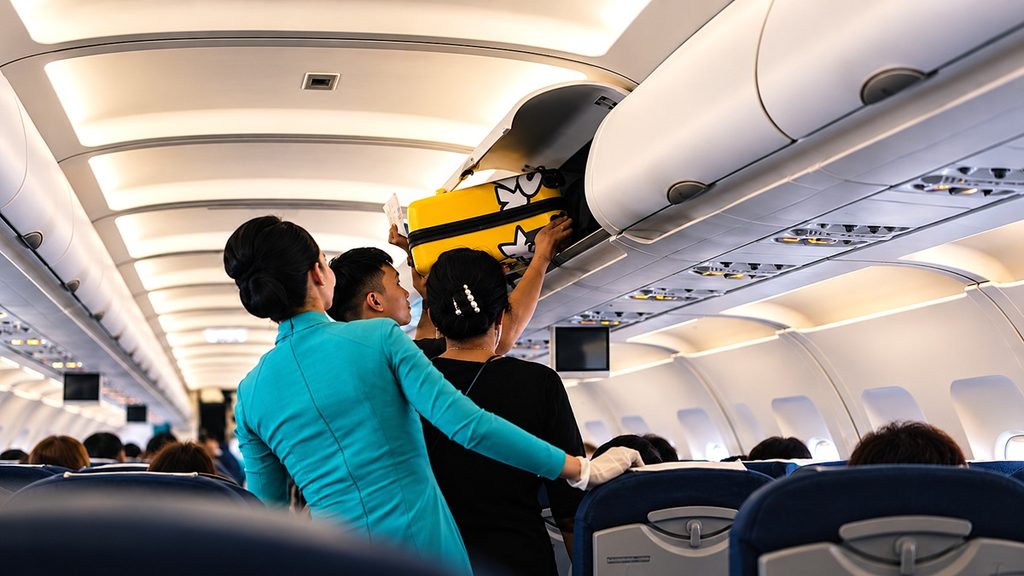
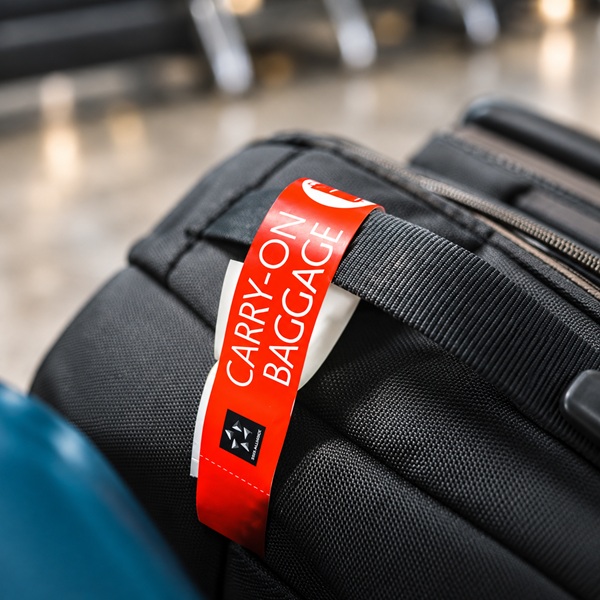
Cabin baggage is luggage that you take through airport security and bring with you onto the aircraft rather than checking it into the aircraft hold.
You may also hear it described as:
- cabin luggage
- carry-on baggage
- carry-on luggage
- hand baggage
- hand luggage
These terms generally describe the same category of baggage, although airlines may use different wording. However, cabin baggage itself can usually be divided into two categories.
Personal item
This is normally a smaller bag that must fit underneath the seat in front of you.
It might be:
- a handbag
- small backpack
- laptop bag
- briefcase
- small travel bag
Larger cabin bag
This is normally a small suitcase or larger backpack designed to fit inside the overhead locker. The important point is that not every ticket automatically includes both. Some fares include only the small personal item. If you want to take a larger wheeled suitcase into the cabin, you may have to pay for it separately or buy a fare that includes it.
2. Why are cabin baggage rules so confusing?
There is no universal cabin baggage size or weight limit. Every airline can set its own allowance, and the rules can vary according to:
- the airline
- the fare you purchased
- travel class
- route
- aircraft
- frequent-flyer status
- whether another airline operates part of your journey
This means a suitcase that was perfectly acceptable on your outbound flight might not qualify on another airline for the return journey. For example, easyJet currently includes a small under-seat bag measuring up to 45 × 36 × 20 cm, while Ryanair’s included small personal bag is currently limited to 40 × 30 × 20 cm. Both airlines offer options for passengers who want to carry a larger cabin bag.
Long-haul airlines can have different rules again. Emirates, for example, currently permits one Economy Class carry-on weighing up to 7 kg and measuring no more than 55 × 38 × 22 cm. This is why labels such as “airline approved”, “cabin approved” or “carry-on size” should be treated carefully when buying luggage.
A suitcase cannot really be approved for every airline when airlines use different limits.
Tripenger Tip
Before buying a cabin suitcase specifically for a flight, check the dimensions permitted by the airline you are actually travelling with rather than relying only on the manufacturer’s description.
3. The mistake travellers often make: forgetting the wheels
Imagine your airline permits a cabin bag measuring: 55 × 40 × 20 cm
You measure the suitcase itself and get: 53 × 39 × 20 cm
Perfect, except the wheels add another 4 cm.
Your actual suitcase therefore measures: 57 × 39 × 20 cm
It may now be oversized.
Airline dimensions commonly include everything attached to the bag, including:
- wheels
- handles
- side handles
- external pockets
- protective feet
- anything protruding from the suitcase
Both easyJet and British Airways, for example, specifically state that their published cabin-bag dimensions include wheels and handles. This is especially important with four-wheel spinner suitcases because the wheels can add several centimetres to the overall height. Measure your suitcase from its furthest points, not just the main shell.
4. Cabin baggage size vs weight: both matter
Size and weight are two completely different baggage restrictions. A suitcase can be small enough for the cabin but still be too heavy. It can also be extremely light but physically too large.
For example:
Bag A
Size: Within the airline limit
Weight: 12 kg
Airline limit: 7 kg
The suitcase may still be rejected or charged as excess baggage.
Bag B
Weight: Only 5 kg
Size: Larger than the permitted dimensions
The fact that it is light does not necessarily make it acceptable. Airlines also take very different approaches to weight. Emirates currently limits an Economy Class carry-on to 7 kg, while easyJet currently allows its cabin bags to weigh up to 15 kg, provided passengers can lift and carry their own bags.
The lesson is simple:
Check both the dimensions and the weight before leaving for the airport. Do not assume that because your suitcase fits inside an overhead locker it automatically meets your airline’s baggage policy.
5. Personal item vs cabin bag
The difference between a personal item and a cabin bag is one of the biggest sources of confusion. A personal item is normally the smaller item that fits underneath the seat. A cabin bag is generally the larger item stored in an overhead locker.
For example, an airline might allow:
1 personal item
Maximum size: 40 × 30 × 20 cm
Stored: Under the seat
and, depending on your fare:
1 larger cabin bag
Maximum size: 55 × 40 × 20 cm
Stored: Overhead locker
The problem arises when passengers see the words “cabin baggage included” without checking exactly what that means. On some tickets, your small backpack or handbag is the cabin baggage allowance. A full-size wheeled cabin suitcase might cost extra. This is particularly common with low-cost airline fares.
6. Can you take a handbag and laptop bag in addition to cabin baggage?
Sometimes, but definitely not always. One of the most expensive assumptions you can make is:
“They won’t count my handbag.”
Airlines can count every separate piece you bring to the gate. Your handbag, laptop bag or backpack may qualify as your personal item rather than an additional free item. Ryanair, for example, currently describes its included 40 × 30 × 20 cm personal item as something such as a handbag or laptop bag. If that is the only baggage included in your fare, you cannot simply assume that you can also bring another backpack free of charge. Other airlines are more generous. British Airways currently permits both a smaller under-seat handbag and a larger cabin bag within its cabin-baggage allowance. Aer Lingus currently allows a small personal item, such as a handbag or laptop bag, in addition to its applicable 10 kg baggage arrangements.
What if you have a laptop?
The laptop itself is usually not the problem. The bag containing the laptop is what matters when counting baggage pieces. If your ticket permits one small personal item, your laptop bag could be that item.
If you then arrive with:
- one cabin suitcase
- one laptop bag
- one handbag
you may effectively be carrying three pieces. Whether that is allowed depends entirely on your ticket.
A useful packing trick
If your fare allows only one personal item, leave enough space to place your small handbag inside your backpack or cabin bag before boarding. That can turn two separate pieces into one compliant bag.
7. What liquids can you take in cabin baggage?
This rule is becoming more complicated rather than less complicated because newer airport scanners are gradually changing security procedures. For many travellers, however, the safest rule remains:
Assume liquids must be in containers of 100 ml or less unless your departure airport specifically states otherwise.
At EU airports, the current general rule allows liquids in containers of no more than 100 ml, packed inside a transparent resealable plastic bag with a maximum capacity of one litre. The container size matters, not how much liquid is left inside it.
For example:
Allowed:
A 100 ml toothpaste tube containing 100 ml.
Not normally allowed under the 100 ml rule:
A 200 ml toothpaste tube containing only 30 ml.
The container is still capable of holding 200 ml.
What counts as a liquid?
It is much broader than drinks. Security rules can treat the following as liquids or liquid-like products:
- water and other drinks
- perfume
- shampoo
- shower gel
- toothpaste
- creams
- lotions
- liquid make-up
- mascara
- lip gloss
- shaving foam
- aerosols
- syrups
- soup
- jam
- honey
- sauces and similar products
The EU specifically includes gels, aerosols, pastes and liquid-solid mixtures within its liquid restrictions.
But aren’t some airports allowing larger liquids now?
Yes.
This is where travellers need to be particularly careful.
At UK airports, for example, gov.uk currently advises that the rules depend on the airport. Most still restrict containers to 100 ml, while some airports may permit containers of up to 2 litres because of newer security equipment.
That means you should check:
- your departure airport
- any airport where you pass through security during a connection
- the airport used for your return journey
Do not assume the rules at your home airport will be identical everywhere else.
8. Medicines, baby milk and other liquid exceptions
There are exceptions to standard liquid restrictions. At EU airports, essential medicines, baby food and baby milk required for the journey can be permitted in quantities greater than 100 ml, although additional checks may be required. Similar exemptions operate in many other countries. If you are travelling with prescription medication, particularly larger quantities of liquid medication, it is sensible to carry supporting documentation and check the rules of both your departure airport and destination. The UK, for example, permits essential liquid medicines above the standard limit but may require proof such as a prescription or doctor’s letter in certain circumstances. Do not move essential medication into checked baggage simply to avoid dealing with cabin liquid rules unless you have confirmed that this is appropriate. Keeping medication you may need during the journey in your cabin baggage also protects you if your checked suitcase is delayed.
9. Can you take a power bank on a plane?
Yes, in most cases, but a power bank belongs in your cabin baggage, not your checked suitcase. This is one of the most important baggage rules travellers should know. Power banks contain lithium batteries. IATA advises passengers not to place spare lithium batteries or power banks in checked baggage. If your cabin suitcase is taken from you at the boarding gate and placed in the aircraft hold, remove your power bank before handing over the bag.
The same principle applies to spare lithium batteries.
How large can a power bank be?
Battery capacity for aviation purposes is normally expressed in watt-hours (Wh). IATA’s 2026 passenger guidance states that passengers should be limited to a maximum of two lithium-ion power banks not exceeding 100 Wh each, while also noting that individual airlines may impose stricter conditions. Many ordinary phone power banks fall below 100 Wh. If your power bank only displays milliamp-hours (mAh), you may be able to calculate an approximate watt-hour rating using:
Wh = (mAh × voltage) ÷ 1,000
For example, if a 20,000 mAh power bank uses a nominal 3.7V battery:
20,000 × 3.7 ÷ 1,000 = 74 Wh
However, always check the actual specifications printed on your device and your airline’s policy.
What about smart luggage?
Some suitcases include built-in batteries for charging phones, GPS tracking or other features. IATA advises that smart luggage with removable lithium batteries should have the battery removed where required, particularly if the suitcase is going into the hold. Non-removable battery systems can create problems depending on the airline. Check before travelling rather than discovering the restriction at bag drop.
10. Travelling with babies: do baby bags count?
Travelling with an infant introduces another set of baggage rules. Do not automatically assume that a baby receives the same cabin baggage allowance as an adult.
Airlines may separately permit:
- a baby changing bag
- pushchair or stroller
- car seat
- travel cot
- baby carrier
- infant checked baggage
But the exact allowance varies considerably. For example, Ryanair currently allows a baby bag of up to 5 kg for an infant travelling on an adult’s lap, along with two pieces of baby equipment free of charge per child. easyJet currently allows an additional baby changing bag for an infant travelling on an adult’s lap, subject to its specified dimensions. The important word here is additional. Some airlines specifically grant an extra baby bag. Others structure infant allowances differently.
Before travelling with a baby, check separately for:
Infant cabin baggage
Baby changing bag
Pushchair/stroller
Car seat
Travel cot
They may all have different rules.
11. Can golf clubs and sports equipment go in cabin baggage?
Usually, larger sporting equipment should not be treated as ordinary cabin baggage. Golf clubs are a good example. Even if you could somehow fit a golf club inside a large bag, security restrictions can prevent clubs and similar blunt instruments from being carried into the aircraft cabin. EU aviation security rules prohibit items including certain clubs and bats from hand luggage. Golf equipment is therefore normally handled as checked or special sports baggage.
Airlines may have dedicated rules for:
- golf clubs
- bicycles
- skis
- snowboards
- surfboards
- diving equipment
- fishing equipment
- rackets
- other sporting equipment
Aer Lingus, for example, treats items including golf bags, fishing equipment, surfboards, skiing equipment and snowboards as sports equipment under its baggage rules. Do not assume that purchasing ordinary checked baggage automatically covers every piece of sporting equipment. Depending on the airline, sports equipment may be included within an allowance, charged separately or require advance booking.
What about tennis or badminton rackets?
Smaller rackets are less straightforward because airline dimensions and airport security rules can differ. Even if a racket is permitted through security, it must still comply with your airline’s baggage size and number-of-items rules. For unusual sports equipment, check with both the airline and relevant airport security authority before travelling.
12. What happens if your cabin bag is too big?
At some airports, your airline may ask you to place your bag inside a baggage sizer. If it fits comfortably, you can proceed. If it does not, several things can happen.
The airline may:
- charge an additional baggage fee
- tag the suitcase for the aircraft hold
- require you to check it in
- refuse it as cabin baggage
The exact procedure depends on the airline. easyJet, for example, states that bags larger than the allowance or additional bags can be placed in the hold and charged the applicable airport bag fee. This highlights an important point:
Paying an oversized cabin-baggage charge does not necessarily mean the airline will allow the suitcase into the cabin.
You may pay more money and still have the bag taken to the hold. Gate baggage charges can also be significantly less pleasant than arranging baggage while making your booking, so it is worth sorting out your allowance in advance.
13. Why might an airline check your cabin bag into the hold for free?
Not every cabin bag that goes into the hold has done something wrong. Sometimes the suitcase is completely within the permitted allowance, but the aircraft simply does not have enough overhead locker space. In this situation, an airline may ask passengers to surrender larger cabin bags at the gate so that they can be placed in the hold. British Airways, for example, states that its smaller under-seat handbag is guaranteed in the cabin while the larger cabin bag may sometimes need to travel in the hold. easyJet also explains that some eligible large cabin bags may be placed in the hold when locker space is unavailable.
Aer Lingus has another interesting system
On applicable European journeys, Aer Lingus currently allows passengers who do not have an onboard 10 kg cabin bag included in their booking to drop a 10 kg cabin-sized bag at check-in free of charge. Their small personal item can still come into the cabin. Taking the same 10 kg bag to the gate without the required onboard entitlement can result in a fee. This is a good example of why the phrase “10 kg bag included” does not necessarily tell you where that bag will travel.
Check whether your allowance means:
- cabin bag in the overhead locker
- bag dropped at check-in
- checked baggage in the hold
They are not necessarily the same thing.
Before handing over a cabin bag at the gate
Remove anything you cannot afford to lose or anything that should not travel in the hold, including where appropriate:
- passport
- wallet
- keys
- medication
- important documents
- power banks
- spare lithium batteries
- fragile valuables
IATA specifically advises passengers to remove lithium batteries and devices if cabin baggage is taken at the gate for carriage in the hold.
14. Connecting flights: the baggage rule that catches people out
Cabin baggage becomes even more complicated when your journey involves more than one airline.
Imagine you book:
Dublin → Istanbul → Harare
or:
London → Doha → Johannesburg
Your first flight’s cabin baggage allowance may not necessarily be identical to the second flight’s allowance.
This becomes particularly important when flights are:
- operated by different airlines
- sold as codeshares
- booked separately
- combined using separate tickets
An airline may market your booking even though another airline actually operates the aircraft. Aer Lingus specifically warns that if a journey is partly or entirely operated by another airline, the baggage allowance may differ. British Airways provides similar advice for flights operated by partner airlines.
Check the operating airline
When looking at your itinerary, find wording such as:
Operated by [Airline Name]
Then check that airline’s cabin baggage policy as well. For multi-airline journeys, the safest approach is to make sure your cabin bag complies with the most restrictive allowance that may apply to your flights. Otherwise, a suitcase accepted on the first aircraft could become a problem later in your journey.
Connecting with duty-free liquids
Connections can also affect liquids. You may pass airport security again during transit. EU rules allow qualifying duty-free liquids through security when they remain properly sealed in the security bag with proof of purchase. But international transfer procedures differ. If you are buying a large bottle of perfume, alcohol or another liquid during a journey involving connections, ask the duty-free retailer whether it will comply with the security rules at your transfer airport.
15. Can you take food in cabin baggage?
Generally, many solid foods can be carried in cabin baggage, but liquid and semi-liquid foods can fall under airport liquid restrictions.
Items such as:
- soup
- jam
- honey
- syrups
- sauces
can be treated as liquids for security purposes. Both EU and UK guidance include several of these products within liquid restrictions.
There is another issue to consider after security:
Customs and biosecurity rules at your destination.
An airport may allow you to take a food product onto the aircraft while your destination country may restrict you from bringing that product through customs. Meat, dairy products, fruit, vegetables, seeds and other agricultural products can be subject to particularly strict import rules in some countries. Security permission and customs permission are two separate things.
16. Cabin baggage mistakes that could cost you money
Many baggage charges are avoidable. Here are some of the most common mistakes to watch for.
Measuring the suitcase without its wheels
Always measure the entire bag, including wheels and handles.
Checking dimensions but forgetting the weight
A perfectly sized suitcase can still exceed the airline’s weight limit.
Assuming a handbag doesn’t count
It may be your personal item.
Assuming a laptop bag is automatically free
The laptop may be allowed onboard, but the laptop bag can still count towards your permitted number of bags.
Buying an “airline-approved” suitcase without checking your airline
There is no universal cabin size.
Bringing an overhead cabin bag when your fare includes only an under-seat bag
This is particularly common with low-cost airline fares.
Packing a power bank in checked baggage
Power banks and spare lithium batteries should be kept in cabin baggage in accordance with applicable airline safety rules.
Using a large container with only a little liquid inside
Where the 100 ml rule applies, a half-empty 200 ml bottle is still a 200 ml container.
Checking only the first airline on a connecting itinerary
Another operating airline may have a smaller allowance.
Assuming baby bags never count
Some airlines provide an additional infant bag, but the allowance is airline-specific.
Arriving with golf clubs as ordinary luggage
Sports equipment can have separate baggage, security and booking requirements.
Leaving valuables in a cabin bag that gets gate-checked
Always be prepared for the possibility that a larger cabin bag may have to travel in the hold.
Cabin baggage checklist before you fly
Before leaving home, check these five things:
1. How many bags does your fare include?
One personal item? A personal item and a cabin suitcase?
2. What are the maximum dimensions?
Measure wheels and handles too.
3. What is the maximum weight?
Use luggage scales if your airline has a strict limit.
4. Are your liquids compliant with your departure and connecting airports?
Do not assume every airport has the same scanner rules.
5. Are batteries, medication and valuables packed correctly?
Keep power banks and spare lithium batteries out of checked baggage and make sure essentials can be removed quickly if your cabin suitcase is gate-checked.
Final thoughts
Cabin baggage rules are confusing because there is no single worldwide standard. A small suitcase can be free on one airline, chargeable on another and too large for a third. A handbag may be an additional personal item on one booking but your entire free allowance on another. Even airport liquid rules can now differ depending on where your journey starts or connects. The safest approach is not to rely on what happened on your previous flight.
Before every journey, check:
your airline + your fare + your operating carrier + your departure and connecting airports.
Five minutes spent checking those details before packing can save you an unexpected baggage fee, and an unpleasant argument at the boarding gate.